
Red Frequency Files – File 002: Tesla’s Blueprint for Conscious Command
Exploring Nikola Tesla’s resonance principles as a metaphor for cognitive coherence and conscious self-regulation in the digital age.
8/29/20253 min read
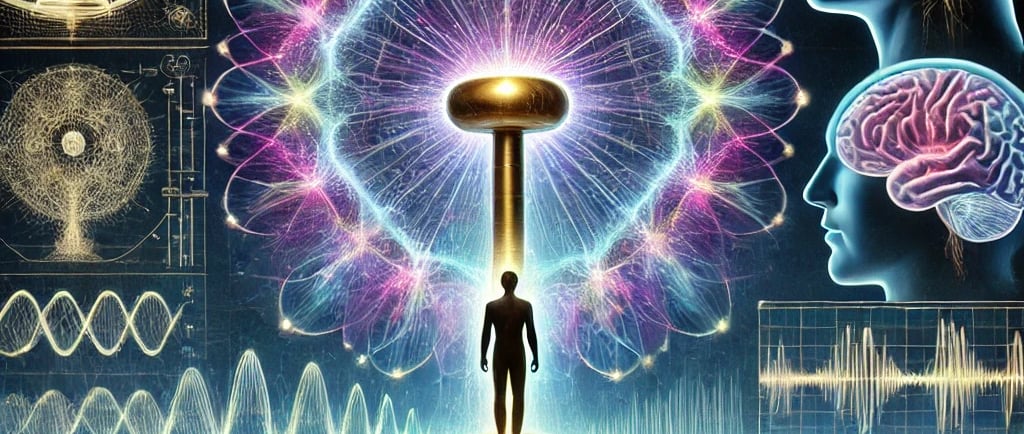
Red Frequency Files
File 002 – Tesla’s Blueprint for Conscious Command
Exploring resonance as a metaphor for cognitive coherence and attentional control.
Executive Overview
Nikola Tesla revolutionized the modern world through his understanding of resonance, energy transmission, and harmonic systems. His theories, though grounded in the physics of his time, offer a provocative lens for exploring cognitive and behavioral dynamics in the 21st century.
This document examines:
Verified principles of resonance in physical systems.
Modern neuroscience on brainwave entrainment and attention modulation.
Speculative frameworks for applying resonance concepts to conscious self-regulation.
Our goal remains consistent: separate established knowledge from conceptual exploration while fostering inquiry into the architecture of attention and mental control.
Tesla’s Documented Principles
Tesla’s wireless power experiments demonstrated that resonance amplifies energy transfer when oscillating systems share harmonic frequencies. In his writings, he often alluded to universal principles governing energy and vibration, framing resonance as a fundamental law of nature (Seifer, 1996).
(Contextual Note: Tesla’s philosophical statements should not be conflated with experimental evidence. Their relevance here is conceptual, not empirical.)
Interpreting the Blueprint (Conceptual & Speculative)
Tesla’s resonance principle raises a compelling question:
If physical systems can synchronize and amplify energy through harmonic alignment, could cognitive systems exhibit similar dynamics in mental states?
While Tesla never proposed such an application, this inquiry aligns with two core observations:
The brain operates as an electrochemical system exhibiting rhythmic oscillations.
Cognitive performance correlates with patterns of synchronization across neural networks.
(Speculative Boundary: Analogies between EM resonance and neural entrainment remain conceptual. They do not imply identity of mechanism.)
Modern Science Touchpoints
Neural Oscillations
Cognitive processes such as attention, working memory, and perception are linked to rhythmic brain activity:
Theta (4–8 Hz): Associated with focused attention and memory encoding.
Gamma (30–100 Hz): Linked to information integration and high-level cognition.
Synchrony within and between these bands supports efficient neural communication (Buzsáki, 2006).
Entrainment Research
External rhythmic stimuli can influence neural activity:
Auditory Entrainment: Binaural beats induce frequency-following responses measurable via EEG (Garcia-Argibay et al., 2019).
Visual Flicker Stimulation: Modulates cortical oscillations, impacting attention and mood (Notbohm et al., 2016).
(Clarification: These effects are real but modest. Claims of profound consciousness programming exceed current evidence.)
Toward a Framework for Conscious Command
Based on these findings, a hypothesis emerges:
Signal Integrity (Metaphorical) = Maintaining stable, coherent attention patterns despite environmental “noise.”
Techniques for signal integrity may involve:
Cognitive Rhythm Design: Leveraging consistent schedules and sensory inputs.
Attention Hygiene: Limiting algorithmic interference that fragments cognitive coherence.
Entrainment-Based Interventions: Using structured stimuli to enhance focus states (within evidence-based bounds).
(Speculative Disclaimer: These strategies extend from correlational evidence and conceptual analogy, not established causal models.)
Closing Inquiry
If resonance enables machines to transmit energy across space with minimal loss, what might mental resonance enable for human potential?
Could the future of conscious command involve deliberate tuning of neural rhythms to resist cognitive interference and amplify focus?
Or does this analogy break at the boundary of biology and physics?
Disclaimer
This file combines verified neuroscience with conceptual exploration. All claims about neural entrainment and attention modulation are supported by existing research, while any application of Tesla’s principles to consciousness remains hypothetical. Readers are urged to evaluate all frameworks critically and consult primary sources for validation.
Research Sources & Further Reading
Buzsáki, G. (2006). Rhythms of the Brain. Oxford University Press.
Garcia-Argibay, M., Santed, M. A., & Reales, J. M. (2019). Efficacy of binaural auditory beats in cognition, anxiety, and pain perception: A meta-analysis. Psychological Research, 83(2), 357-372.
Notbohm, A., Kurths, J., & Herrmann, C. S. (2016). Modification of brain oscillations via rhythmic light stimulation provides evidence for entrainment but not for superposition of event-related responses. Frontiers in Human Neuroscience, 10, 10.3389/fnhum.2016.00010.
Seifer, M. J. (1996). Wizard: The Life and Times of Nikola Tesla. Citadel Press.
Red Frequency Files is sustained by readers who resonate with the mission.
If you’ve found value here, consider supporting the fieldwork:
👉 paypal.biz/fdafrequencysupport
🛰️ MISSION INSIGHTS
Tactical strategies decoded from the noise. Mission-ready insights for business operators who refuse to guess.
📡 CONNECT & FOLLOW
📦 Lock in weekly Red Frequency Drops—growth hacks, intel briefs, and algorithm-proof tactics. No spam. No noise.
🔰 FRONTLINE DIGITAL AGENCY
Lead. Follow. Or get outta my algorithm.
© 2025. All rights reserved.
📬 INTEL DROPS
🏅 Veteran-Owned | Florida HQ
🧠 HQ COMMS
Tap in with Frontline. Stay synced. No fluff, just signal.